Life in the Left Lane: Driving on St. Croix
Driving on St. Croix is its own adventure.
.svg)
Island Customs Every Visitor Should Know
St. Croix has its own rhythm, its own expressions and a few unwritten customs that are worth knowing before you arrive. Learn to lead with “good morning,” understand what it means to be limin’, and remember that slowing down a little is part of being here.
If there is one thing we'd tell every first-time visitor to St. Croix, it's this: greet people properly before you say anything else.
“Good morning.” “Good afternoon.” And once evening arrives, “good night”—often the wonderfully emphatic “good night, good night.”
On St. Croix, a greeting isn't just a formality. It's an acknowledgment of the person you're speaking to. Walk into a shop or approach someone and immediately launch into a question, and you may come across as abrupt.
We learned this lesson early.
Not long after we began spending time on St. Croix, we were in downtown Christiansted looking for an art gallery. Tim stepped into a nearby restaurant and immediately asked a man inside for directions.
He had skipped a step.
The man gave Tim a short, slightly stern—but well-intentioned—lesson about the importance of offering a proper greeting before asking a question. Then he gave him the directions.
And they became friends.
Tim has remembered the lesson ever since.
It's a small thing, but one that tells you quite a lot about St. Croix. People acknowledge one another here.
And if “good night” sounds strange as a greeting at first, you'll get used to it quickly. Here, it doesn't necessarily mean goodbye. It may simply mean hello after dark.
.jpg)
The tradition is so much a part of Virgin Islands life that it even inspired a song.
St. Croix part-time resident Dan Aykroyd joined local musicians and G. Love to record “Good Morning, Good Afternoon, Good Night,” a musical tribute to the Virgin Islands. Aykroyd performs as his legendary Blues Brothers character, Elwood Blues. The song itself tells a familiar island story: someone arrives in the Virgin Islands and is welcomed into the community.
VI Peeps featuring Motta, Jeff Tareila, Elwood Blues and G. Love & Special Sauce
You certainly don't need to speak the Crucian dialect to enjoy St. Croix—and we wouldn't suggest trying too hard. But knowing a few words and expressions can help you understand a little more of what you hear around you.
Hanging out. Relaxing. Enjoying yourself without much of an agenda. Sitting under a sea grape tree at Cane Bay with nowhere you particularly need to be?
You're limin’.
Thing. A simple word you'll hear frequently once your ear begins to pick up the local cadence.
Depending on how it's used, roughly “really?” or “is that true?” The St. Croix Explorer translates Fa true? as “Do you mean it?”
Born here. Someone who is bahn ya was born on St. Croix. It's more than another way of saying someone lives on the island.
A little goes a long way. You don't need to start speaking like a Crucian to appreciate the language and rhythms of the island.
.jpg)
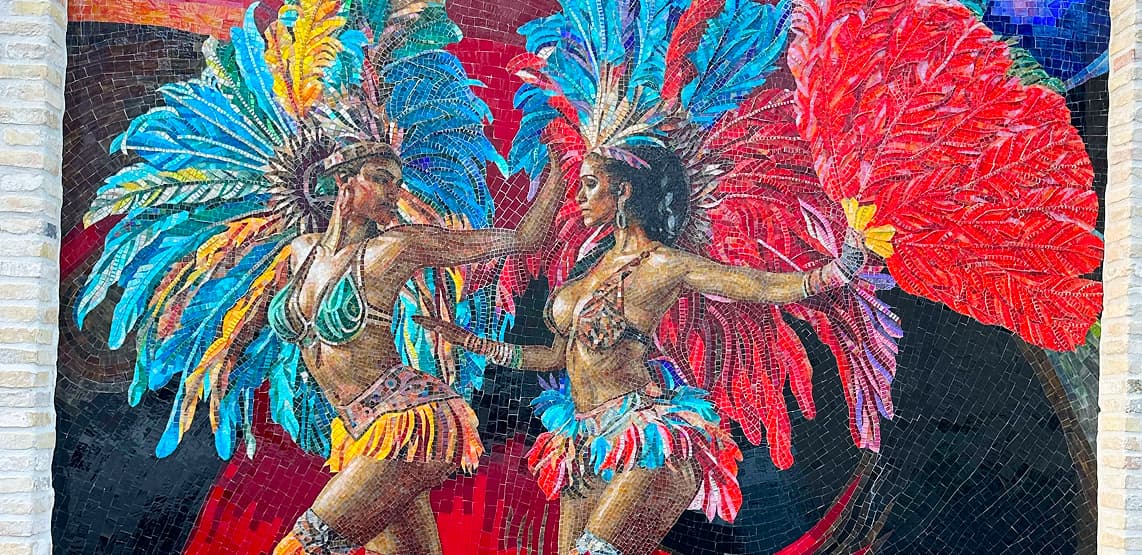
One of the most memorable sights in the Virgin Islands is a Mocko Jumbie dancing high above a crowd on stilts. They're colorful, exuberant and enormously entertaining—but there's much more behind the tradition than the spectacle.
Mocko Jumbies trace their roots to West African spiritual traditions brought to the Caribbean by enslaved Africans. The word jumbie refers to a spirit or ghost in Caribbean folklore. Mocko—also spelled Moko—is generally associated with an African spirit or deity and with the stilt-walking traditions that developed across the Caribbean.
The extraordinary height isn't simply for show. Traditionally, the elevated figure could see farther than ordinary people and watch over the community, while also warding off evil spirits. Over generations, those traditions evolved and took on distinct forms throughout the Caribbean.
In the U.S. Virgin Islands, Mocko Jumbies have become an important symbol of cultural identity. You'll see them dancing at Carnival and festival celebrations, parades, Jump Ups and other special events—often in elaborate, brilliantly colored costumes, balancing and dancing on stilts that can put them well above everyone around them.
And they don't simply walk.
They combine extraordinary skill with a tradition whose roots reach from West Africa through generations of Virgin Islands culture.
Watching them dance, turn and interact with the crowd while perched so high above the ground gives you an entirely different appreciation of the skill involved. It's joyful to watch, but it also carries forward a tradition with roots reaching back centuries.
St. Croix is casual. Very casual.
But there's still a distinction between what you wear at the beach and what you wear when you leave it.
A swimsuit is perfectly appropriate at Cane Bay, Rainbow Beach or around the pool. If you're heading into Christiansted, stopping at the grocery store, shopping or going to a restaurant, put on a cover-up, shirt, shorts or sundress.
You don't need to dress up. It's simply a matter of recognizing that St. Croix isn't a resort created for vacationers. It's a community where people live and work.
A little consideration goes a long way.
This one can take some practice.
Things don't always happen precisely when you expect them to on St. Croix. We know this firsthand.
We'll be at the house waiting for someone who's supposed to arrive to repair something or provide a service. The appointed time comes. Then it goes.
Our mainland instincts start kicking in.
And then we remind ourselves where we are.
We're on island time. Take a deep breath. Relax.
The person gets there. The work gets done. And getting frustrated rarely makes any of it happen faster.
That's not to say schedules don't matter or that everything on St. Croix runs late. They do, and it doesn't. But we've found that bringing a little flexibility with us makes island life considerably more enjoyable.
And the slower pace has its rewards.
A greeting can become a conversation. The bartender may tell you somewhere you should go. Someone sitting next to you may tell you where to find a great pâté. Some of our favorite discoveries on St. Croix have come from conversations we weren't planning to have.
Perhaps that's another form of limin’.
.jpg)
The easiest way to understand most of these customs is simply to remember that St. Croix is a real community, not a Caribbean resort created for tourists.
People work here, raise families here and have generations of history here. Visitors are warmly welcomed, but showing a little curiosity about the culture—and a little respect for the way things are done—makes the experience better on both sides.
Say good morning.
Put on a cover-up when you leave the beach.
Don't be afraid to have a conversation.
Learn a ting or two.
And when the sun goes down?
Good night.
Greetings:
Always begin with good morning, good afternoon, good evening or good night.
What to wear:
St. Croix is casual, but cover up when you leave the beach or pool.
Island time:
Leave a little room in your schedule—and your expectations—for things to move at their own pace.
Driving:
We drive on the left. Potholes, steep roads and a few routes you really shouldn't take are another story. We'll tackle those Next.
.jpg)
.jpg)
.jpg)
.svg)